Bellerin’ mavericks holdin’ down, every outfit brandin’”
Jack Lee, “Powder River, Let ‘er Buck”
Joe D. Hawes met me in Tivoli, Texas. “Turn right at the crossroads with the traffic light. You won’t miss it,” he told me. “There’s only the one light.” Sure enough, on a foggy morning a single orange light blinked tentatively as I approached, after a 50-mile run from Corpus Christi out along the Gulf Coast. If this township was a tribute to the Tivoli Gardens in Copenhagen it had some way to go in the illumination stakes.
Joe’s pickup was exactly where he’d said I would find it. A maroon Chevy Silverado pickup with an aluminium gun rack. Joe climbed down from the truck. He was all Texan. Tall, barrel-chested. Cowboy hat, work shirt, denim jeans and boots. A crinkled, weather-beaten, kind smile. “Welcome,” he said. “Follow close behind me. We’re heading out to the boondocks.”
The boondock in question was Joe’s ranch, Rancho Riacho—“we called it after a funny little creek”—where he lived with his wife Marjorie. They married in 1940, when she was seventeen and Joe was twenty, and now in his late eighties Joe was still keeping cattle. And more importantly, he was still running cattle out on the Matagorda Peninsula where, in the 1840s, a sometime rancher named Samuel Maverick had run cattle too, the cattle that carried his name into the English language.
From the turnoff to Rancho Riacho we lumbered over a mile or more of rutted tracks, through muddy fords, over a timbered bridge crossing that funny little creek and past squat mesquite trees that looked as if their trunks were buried underground and only their highest branches had made it to the surface. Unfazed cattle watched us nonchalantly. As we drew up to Joe’s house, a posse of wild turkey pottered across the track. In a townie kind of way, I ventured that up until then the only wild turkey I had ever seen was inside a bottle of bourbon. Joe laughed kindly as he leaned up against the gate to the ranch house. On top of the gate discolored metal letters spelled out J. D. HAWES. “All rusted up, just like me,” said Joe sadly. He was getting ready for a hip replacement operation. “Been getting around on one leg for a while now. That’s old age, I guess.” But although his gait was a little stiff, he was still 100 percent prime rancher and, to my untrained eye, looked pretty damn healthy.
He and Marjorie had moved out here in the early 1970s, away from the coastline. A hurricane had wiped out one of their homes in Port O’Connor—“we never did found out where the house ended up”—and eventually they headed inland for a little more security. However, Joe knew the Gulf Coast, and the Matagorda area in particular, better than most. He was born on Matagorda Island, lived there until his twenties and was the locally acknowledged expert on the area.
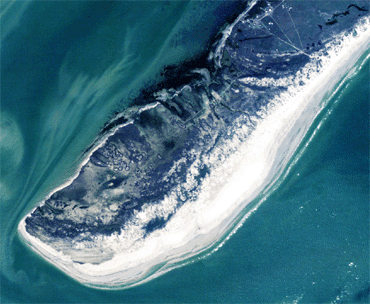
First, a little geography. The Matagorda Peninsula, where Samuel Maverick kept his cattle, and the adjacent Matagorda Island are part of a ribbon of barrier lands that sweep along and protect nearly the entire arc of the Gulf Coast of Texas for more than 350 miles, from Galveston up near the border with Louisiana right down to the frontier with Mexico by Brownsville. The Matagordas form the central sector, the peninsula jutting out from the mainland near Sargent, some 40 miles south of Houston. The island lies immediately to the southwest and points the way down to Corpus Christi and onwards to the barrier’s southernmost landfall, the hedonistic playground of South Padre Island, America’s very own Cancún. (The particular padre in question, by the way, was a Mexican priest named Padre José Nicolás Ballí.)
The coastline is in constant flux, and winds and storms have determined the shape not only of the coast but also of the area’s history. The weather is unpredictable, and hurricanes are an intermittent life-changing event. The impact that Katrina had on New Orleans in August 2005 has been acted out along the Gulf coast, but with less 24/7 news coverage, for centuries. In 1900, for example, Galveston, then the thriving port of east Texas, was shattered by a hurricane, and its role as a boomtown was picked up, but never handed back, by Houston. On Matagorda Bay itself the town of Indianola, a rival to Galveston in its own heyday, was wiped out in 1875.
Joe had lived through more than a few of these intense blasts and understood the realities of life on such a low-lying coast. “The island is quite high; our ranch house there always withstood the storms. But Matagorda Peninsula has a real low elevation. Figure on it. If you’re gonna build on the coast on a little low place you’re gonna git hit by those storms. It’s one of the penalties you pay for living out there.”
The worst experience in Joe’s life had been Carla in 1961, a Category 4 hurricane that smacked into the area with winds of 120 mph and took out most of the houses in Port O’Connor, the town on the mainland opposite the peninsula “and half the cattle we had there. We didn’t lose cattle on the island though. They were native, and went to the highest elevation they could find.” There was little insurance when Joe was younger, and even if you were covered it could take from six months to a year for the companies to pay out on a claim. Even now it’s hard to get insurance for any building on the barrier islands.
★
I had realized how vulnerable the Gulf Coast was to extreme weather conditions flying in, or trying to, the night before. The “Flight Delayed” messages were clicking up frantically by the time I landed at Houston for a connection to Corpus Christi. There was only a miniscule possibility of escape from Houston, and the airport corridors were full of frustrated businessmen downing beers, and overpepped-up college kids heading down to South Padre Island for spring break. On the TVs hanging in the full-to-bursting bar the chances of the Dallas Mavericks ball team were being discussed.
Somehow I managed to hustle myself onto the last seat available on an earlier, last-ditch flight south. Through the night sky, the plane rattled and bumped and juddered along the Texas coastline, hightailing it onto terra firma sometime after midnight in the middle of a spectacular storm. The weather in Corpus Christi was suitably biblical: viciously high winds, whipping rain, lightning jags strobe-lighting the sky for the next hour. Fortunately, things had calmed down by next morning, in time for me to find my way to Tivoli.
The Hawes ranch was full of Matagorda memorabilia. Faded photographs of Port O’Connor in its heyday. A wonderfully romantic shot of Marjorie and Joe around the time they got married in 1940, beaming out from a ranch house verandah. A table made from a slice of a huge mahogany tree that had flotsamed up on the beach at Matagorda Island. Joe settled back and told me some of his family history, which would set Samuel Maverick’s experience into context.
Joe’s great-grandfather, Hugh Walker Hawes, a lawyer by profession and already a fairly wealthy man, had come down from Kentucky to the Texas coast in 1839. He foresaw the area as a potential alternative to New Orleans. On Saluria Bayou, on the northeast shore of Matagorda Island, he built up a wharf and warehousing as a location for unloading deep-draft ships that did not want to venture into the shallow bay waters and for transferring the goods they bore onward to the cities of Corpus Christi and Victoria. By the late 1850s he and Saluria were prospering. "He was doing real good," said Joe, "but then the Civil War burned him out, and there was a storm in 1875 and that finished him off. It left him with only his ranching operation on the island."
A tall white stone marks Hugh Hawes's grave underneath the island's lighthouse, near where the Haweses and two other families set up isolated ranch houses. Because Matagorda Bay on one side and the Gulf of Mexico on the other provided two natural fences, the island was simply cross-fenced to demarcate areas where cattle could graze, alongside sheep, horses, geese and hens. The families grew crops and supplemented the produce with fishing and hunting.
It was a hard living, and even into the mid-20th century a pretty rough one, with primitive conditions: no running water or plumbing and no phones. But it was a wholesome existence: swimming on the beaches, riding the sand hills. "We worked hard with the cattle. Fresh air, and lots of it. It was real healthy. We ate a lot of fish, ducks and geese. I don't think you had all them dang diseases back then. Those doctors been busy inventing them ever since."
A coast guard station on the island and the lighthouse boat provided the principal link to the outside world, but a photo in Joe's house showed flat-bottomed barges bringing some Model T Fords out to the islands, the same barges that could transport the Matagorda cattle back to the mainland for sale. When the cattle were ready to ship it was all hands on deck. Breakfast was prepared for twenty or thirty hired workers, each with an unendingly hearty appetite. And before the roundups, the calves had to be caught, flipped, castrated and branded, twice a year, in June and late November, long enough before the cattle sales for the wounds to heal. It was a tradition in the Hawes family that all the kids and grandkids, especially the ones who'd moved away from the islands, should come back and help, go in the pen one-on-one with the calves and try to flip them by hand the old way, something they'd never forget. This was real ranching and cowboy work. The heroic, stylized Hollywood version was an entertaining myth.
Samuel Augustus Maverick was a Texan by choice but a reluctant rancher. He was born in South Carolina, on 23 July 1803; his parents had moved out of Charleston to avoid yellow fever and settled in Pendleton, in the foothills of the Blue Ridge Mountains, to farm orchards and grow vines and dabble in cotton. Samuel's father had endured an education interrupted by the events of the Revolutionary War and did not want his son to miss out as well: Samuel went to Yale, after which he studied law at Winchester in Virginia, returning to South Carolina to practice in the late 1820s.
He departed a few years later, after getting involved in an argument at a public meeting called to discuss the Nullification Question, a bust-up between the state and the federal government of President Andrew Jackson that was one of the tremors presaging the earthquake of the American Civil War. The Mavericks were against the southern states seceding from the Union. When his father was speaking and being constantly interrupted, Samuel challenged the heckler to a duel, wounded him and promptly took the victim home to tend to his injuries.
However, to avoid inflaming the situation, Samuel clearly thought it was wise to leave South Carolina, heading first to Alabama to sample working on a plantation. That did not appeal so he moved on to Texas, which was attracting adventure-seekers like moths to a storm light. In the 1820s the land developer Stephen Austin had promised to reclaim Texas from its Mexican overlords through the "enterprise and intelligence" of North American folk, with strict rules that there should be "no drunkard, no gambler, no profane swearer, no idler." Taking no notice of these criteria, they came anyway, in their droves from New York, Georgia, Kentucky, looking for a fortune (or fleeing bad debts). Samuel Maverick joined them and first arrived in San Antonio in 1835. The town, with its adobe and stone buildings, plazas and generally exotic Hispanic vibe, entranced him, and he decided to stay.
He found himself in the thick of Texas history after only a few weeks. The city, which was challenging Mexico’s rule, was captured by a Mexican force, and Maverick was placed under house arrest, but somehow he managed to persuade his captors that if they released him he would leave the state. Instead, once clear of the city, he hooked up with the rebel Texas army and helped guide them back into the city, using his knowledge of its layout. The Mexican generals surrendered.
In the following year, 1836, Texas declared its independence; it’s easy for a non-Texan to forget that for nine years the state was an independent republic, shrugging off the attentions of both Mexico and the United States. In that fateful year of 1836 Samuel was based at the Alamo but was chosen to be a delegate to the Independence Convention held in east Texas at Washington on the Brazos. Fate indeed—while he was away the siege of the Alamo took place, during which nearly all the Texan defenders were massacred. (Samuel later planted a garden nearby in memory of those who were killed.)
That year of 1836 was significant in Samuel’s personal life too. He visited Alabama, where he had spent time on his way from South Carolina to Texas and met his wife-to-be Mary Ann Adams—she, helpfully, kept a journal for much of their married life. “Gus,” as his family called him, was offered property in South Carolina by his father, but his heart remained set on Texas, and Mary, with the couple’s infant son, accompanied him back to San Antonio in October 1837. She recalled the trip as a particularly harsh journey and that during it they went close to Matagorda Bay, which Samuel wanted to visit “with a view of possibly locating there.” However, they continued on to San Antonio and took up residence on the Plaza Mayor. Their second son, born there in 1839, was, she believed, the first child of pure American stock born in the city, and she the first American woman to make her home there.
By the autumn of 1841 Mary was reporting rumors that Mexican forces were again preparing to invade San Antonio, which they did by surprise attack in the following September. Maverick was again captured. This time, perhaps because of his earlier duplicity, he was sent with fifty other prisoners—”poor luckless Texians,” as he described himself and his co-prisoners—on a long trek to Mexico, lasting two months. They finally arrived in Perote Prison in Vera Cruz, where Samuel was interned until his release in the spring of 1843. “Do not despond,” he wrote in one letter to Mary Ann, reassuring her by describing his daily routine in the castle as one of monotony, although Waddy Thompson, the American minister to Mexico, who helped negotiate his release, recalled him as “a man of fiery and impatient temper, and chafed, under his confinement, like a chained tiger.” Maverick had a particular reason for his anger. When the victorious General Woll had left San Antonio in triumph he commandeered Samuel Maverick’s finest buggy, while his sidekick Colonel Carrasco helped himself to Maverick’s best horse for the ride to Mexico. Apparently, Maverick never forgot this.
On the day he was released from captivity, his and Mary’s second daughter was born; she was named Augusta in her captive father’s honor. By May 1843 he was back in San Antonio, “in splendid health” his wife noted, “and happy as could be.”
★
It was shortly after his release that Maverick relocated his family to Decrows or Decros (either way, pronounce “Deck-rose”) Point on the very western tip of the Matagorda Peninsula.
Maverick had already bought some land at Cox's Point on the bay opposite Port Lavaca, but now they moved across the water to the thin, low-lying strip of land, "a dreary sandy flat," Mary called it, although she liked its proximity to the Gulf of Mexico and its "magnificent, calm, gently heaving water," and enjoyed the fact that every evening her husband would take her down to bathe in the sea.
They started making it as homey as possible, putting a fence up around the place and cultivating a garden. "What delicious watermelons! Flowers, grapevines and orange trees flourished luxuriantly." This was a period of relative stability on all fronts, and after its republican interlude, Texas voted to join the United States in 1845. There was a social life to enjoy in Matagorda City at the far end of the peninsula, which attracted the wealthy planters from the neighborhood, and the city even had an academy for young ladies.
But though their house was shipshape, the bay itself, treacherous for those unfamiliar with its tides and moods, was less manageable. On one occasion Samuel was in a small craft that capsized off Lavaca, but he managed to get rescued just before dusk fell. Another day fog fell in a blanket over a boat the Mavericks and some friends were traveling in; totally losing their bearings, they beached where they could and laid up overnight, huddling in the sailcloths for warmth. Mary's journals frequently mention the bodies of less fortunate neighbors washing up along the shoreline.
While living on Matagorda Peninsula, Samuel Maverick became a rancher by default. Owning cattle never interested him. Land acquisition and real estate were his real passions. "Mr. Maverick," wrote his wife, "was a most earnest and enthusiastic admirer of western Texas, and a firm believer in her future. What a grand home for the toilers of Europe, he would say. All men of strong imagination," she observed, "speculated deeply in land in those days." He carried on acquiring land for the next couple of decades and by the end of the 1860s had become one of the largest landowners in the west of the state. One of his wishes was to be able to travel from San Antonio to El Paso entirely on his own land, just as it used to be said that you could walk from Cambridge to Oxford on land owned by the Trinity Colleges of both universities.
Samuel Maverick was often away on business for weeks, even months. But on March 16, 1847 he was on Matagorda, and there is a significant entry in Mary's journals. She reports that "Mr. Maverick went to Tilton's place, 25 miles up the peninsula, and bought it and four hundred head of cattle at 3 dollars per head." In fact this was not a straight purchase but settlement of a debt. Samuel Maverick was owed $1,200 by Charles Nathan Tilton, and the 400 cattle at $3 cancelled it out.
The property Samuel acquired back along the peninsula had an oyster bayou attached, as well as cattle pens. The family decided to move away from Decrows Point and up to the new house, an eight-room, three-storey frame house, built to resist the storms. "We lived well on the coast, had any quantity of fish, always fine, fruits fresh from New Orleans and splendid gardens. And still we were aware great storms might come and destructive cyclones at equinoxal times."
When Samuel's father heard that he was now a cattle owner, he reminded his son that one of his uncles had once taken a few hundred head of cattle in exchange for a debt and driven them to Pendleton. "Cattle, like an army of men, don't thrive," he warned gloomily.
I asked Joe Hawes what kind of cattle Samuel Maverick might have acquired in the deal. Joe reckoned that they would have been the common longhorn breed, the standard choice of the day, with a massive, distinctive handlebar of bone. The critical factor was that the cows could be turned loose on rough country and left to their own devices. Apart from sturdy cedar trees, the Matagorda Peninsula and island were covered in the thick scrub and brush that—from the Spanish mata gorda—gave the area its name; the peninsula was particularly rich in spartina grass, which grew along the water’s edge and was high in protein, and the cattle would instinctively find their way to it, before moving to other areas and other grasses as the seasons changed.
Joe had told me that looking after cattle was “not too much trouble,” and I’d thought he was being modest, but he insisted it was true. “We never did feed them cattle feed. They worked out where the best grass was; the cattle did the thinking for us.” And when the mosquitoes came, the cattle would go down to the Gulf Coast, because the breeze off the water meant there were no mosquitoes around. At certain times the mosquitoes away from the water’s edge were thick in the air. “I’ve seen it so bad, they even killed a deer; its windpipe got all choked up,” remembered Joe.
Out on the peninsula Joe now ran the Beefmaster, a three-way cross of Hereford and Shorthorn cattle with the Indian Brahman bull, developed in the 1930s by the Lasater Ranch in south Texas. It’s a good breeder and a hardy animal, “tough as a boot.” Joe is dismissive of some of the more pampered varieties of cattle raised for life on less rugged ranches: “Cows today, turn them out on Matagorda, they’d starve to death.” I had the feeling he identified with the old self-sufficient animals, especially when later on, he told me, “People today go through life so fast they don’t know where they’ve been. The young people have never been deprived of anything. The older generation knew where money came from: a different kind of breed.”
The style of ranching where cattle wandered free was the traditional way cattle were run in the mid-19th century. The huge Texan ranches (cue the theme tune of Dallas) were a later phenomenon, made possible only by the arrival of barbed wire, of which the most successful version was patented in the United States in 1874 by Joseph Glidden of Illinois. Barbed wire meant that huge tracts of land could be contained easily and quickly on plains where lumber and stone were in short supply and where fencing off vast acres would have been time-consuming and far from cost-effective. Landowners could swiftly divide up parcels of land huge enough to be measured in units known as RIs (Rhode Islands).
Before barbed wire, however, when cattle did run free, branding was an absolutely essential part of ranching, the only way to keep check on and track of the herds. Each brand was registered with the local cattlemen’s association. The Hawes family’s brand (a T overlaid on an L) was registered in 1873 and used long before that. But Samuel Maverick, although he had a brand mark of MK, failed to oversee its systematic use and gained a reputation for running unbranded cattle on the peninsula.
Shortly after acquiring the herd, he had in any case headed back to San Antonio. Both Samuel and Mary Ann had retained great affection for the place, where they had spent their early married life. They left behind both the cattle—in the care of Jinny and her son Jack, former slaves who worked for them—and the healthy lifestyle they had enjoyed out on the coast. The change of environment had immediate and fatal consequences for the family: within a year of returning to San Antonio one daughter, Agatha, died aged seven, the following year another daughter, Augusta, and an infant baby named John both fell victim to an epidemic of cholera.
While dealing with these personal tragedies—distraction enough—Samuel was receiving letters from acquaintances back in Matagorda reporting that Jack was finding it hard to manage the cattle on his own; others said that they were lost or stolen “from want of proper attention,” or that other ranchers were simply branding them as their own. At one point Maverick was summoned to a meeting to discuss these cattle that they had come to call “mavericks.”
One former resident of Matagorda was Charlie Siringo, born on the peninsula, where he grew up enjoying much the same a definition of the word as being after a “cattle thief named Maverick,” tried to set the record straight. In 1942 Dr. Lewis A. Maverick, writing in the California Forklore quarterly, confirmed that it was the cowboys who herded the cattle for Toutant Beauregard who had spread the term as they moved on to other jobs and thought the word was disseminated during the big cattle drives from Texas up to Montana and the northern states. What is not certain, however, is how and where it crossed over to gain the further meaning of anyone who is nonconformist, and headed out into general usage.
Samuel Maverick did have a certain profile within Texas. Not only was he a noted landowner and a signatory of the Republic of Texas’s Declaration of Independence, but he also held public office, as mayor of San Antonio and a member of the Congress of the Republic (an office he was voted into in absentia when he was imprisoned by the Mexican forces in 1842-3). And the Maverick name was sustained in the public eye in the next century by his grandson, Maury Maverick, a Democratic congressman who represented Texas in the 1930s and who is credited with coining the term “gobbledygook” and called his autobiography A Maverick American. His son, Maury Jr., having failed to get selected for the Senate seat vacated by Lyndon B. Johnson when he became vice president in 1961, became a well-known lawyer fighting civil rights cases.
Other branches of the Maverick family continued to do things differently and never followed the herd. I spoke to Robin Lloyd, who has plenty of Maverick blood in her veins: she is a peace and justice activist, a maker of documentary films about human rights. Robin’s grandmother, Lola Maverick Lloyd, was a granddaughter of Samuel’s, who also kicked against the traces. Lola was a pioneer suffragist who married William Bross Lloyd (one of the founders of the Communist Labor Party of America). She was a moving spirit behind the Peace Ship chartered by Henry Ford during the First World War and became a founder of the Women's International League for Peace and Freedom. Many of Lola's descendants have continued working for civil liberties and world peace; Robin herself had spent time in prison for civil disobedience, defending her beliefs.
Robin told me that even as we spoke three sisters, Maverick descendants, were trying to save the Maverick Ranch outside San Antonio from being flattened to make way for a new highway. "I feel lucky to have this heritage," said Robin. "It means I don't feel I'm the black sheep. We're all black sheep."
Although the Mavericks as a family matched the new meaning of their name, perhaps the reason the broader sense of the word caught on is that it so sweetly fits the Texan self-image of themselves as beings of independent thought and action and of rugged individuality, that "Lone Star State of Mind," as Nanci Griffith sang. James Michener put it another way: "Texans want to believe they're different, a reverberating quality that other places don't have."
And, of course, being a maverick is an image many of us like to convey. If you like to feel you're not a run-of-the-mill person, you say you're a maverick. It's right up there with "mercurial," a handy tag for anybody who zigs where others zag. When Robert Altman, the director of M*A*S*H, Short Cuts and Gosford Park, died in the autumn of 2006, damn near every obituary described him as a "maverick." Madonna called her record label Maverick. The Brazilian business guru Ricardo Semler titled his bestselling book Maverick! The Success Story Behind the World's Most Unusual Workplace. TV allowed James Garner to ensure that Bret Maverick was a household name. And of course, Tom Cruise, in Top Gun, had the call sign Maverick, because, hell, that's the kind of guy he was.
★
I was about to take my leave of Joe and Marjorie Hawes, who had arranged for their son Robbie to take me over to Matagorda Peninsula. Joe has mixed feelings about Matagorda. He loves the island and the peninsula, but he and his family have been locked for decades in a legal wrangle with the U.S. government over the island, a Jarndyce vs. Jarndyce battle that has already clocked up sixty years and rising.
It revolves around an interpretation of the U.S. Constitution’s Fifth Amendment: that no public property can be taken for public use without due cause or compensation. In 1940 the Hawes and the other families had been happily ranching on Matagorda Island for a hundred years. During the Second World War the island was identified as a suitably remote training base for gunnery and bombing practice by the USAF. But there was a population. The government rushed through a condemnation order. Joe’s uncle was up a ladder putting shingles on the ranch house roof when a U.S. marshal arrived, serving papers that gave them, after a century on the island, ten days to clear out and get themselves and their cattle off.
The families didn’t mind giving up their land for the war effort, but they never got it back; after the war they were forced to accept $7 an acre for land (though they were allowed to lease it back) that later went for $1,200 an acre. And don’t mention the mineral rights. The island is now a wildlife reserve, a refuge for the giant whooping crane, which stops off in Matagorda for some R&R. The battle has taken its toll on Joe and his family. Behind the Texan hospitality, I could see from the scars of cold anger and sadness that the saga has tainted the land he grew up on.
Leaving Joe at the gate to the ranch (“Anything else, give me a holler,” he shouted), I drove on to Port O’Connor. Now, Port O’Connor is not somewhere you can swing by. It lies at the end of Highway 185, which heads on through the flatlands, past the occasional oil refinery and railway siding, on and on and on till you hit the sea. At the waterfront by 7th and Commerce, Robbie Hawes runs Boathouse Bait. He’s one of the few shrimpers still working the waters here. Great shrimp too: Majorie Hawes had whipped up a ginormous plate of them for lunch earlier. The day I arrived there was no bait in Robbie’s tanks, where he might store, along with those shrimps, croakers and ribbonfish, mullet, sardines and squid. He pointed out old shrimping sheds across the quay, now reinvented as tourist fishing outlets.
Without much to-do, we dropped ourselves onto his flat-bottomed, two-man fishing boat, and he gunned up the outboard, sending us chop-chopping across scudding waves under a lowering sky, straight out across the wide bay toward Matagorda Peninsula. It was extremely exposed out here, and there wasn’t much to hang on to. I remembered Mary Maverick’s litany of corpses washed up on the beaches and gripped a little tighter. After ten minutes we closed in on the land of the peninsula and followed it down to the tip. Decrows Point was separated from Matagorda Island by the narrow Pass Cavallo, and through the pass the waves of the Gulf of Mexico were churning.
Robbie nosed the boat as close to the beach as he dared without damaging the propeller, and I leapt off the bow onto dry land. (Joe later told me, “I spoke to Robbie. He told me you jumped onto Decrows Point. Said you looked like Columbus!”)
This was Decrows Point. A fishing shack was perched on stanchions a hundred meters or so away, but there was nothing much else to see. It was desolate, though not bleak, and reminded me of long empty stretches of shoreline in Suffolk or along the Atlantic coast of France. I found it very hard to imagine the Mavericks’ house here or their neat garden of watermelons and oranges. And it was certainly bracing. At Joe’s house I’d seen an 1851 ad for Huff’s Hotel at Decrows Point—“the healthiest place on the bay”—but you could see just how fragile this place was and how vulnerable anyone living here would be. Joe had mentioned that the Decrow family lost their home in the storm of 1875; “They thought their fine house was strong, but it was destroyed, and twenty or so of the family drowned that night.”
I paddled back out to the boat, and Robbie crossed the short channel to swing me around the edge of Matagorda Island—its landmark lighthouse proudly extant. The constant ebb and flow of the coastline was revealed by a bay that had been a channel to the ocean but was now closed in to form a sweeping beach where summer visitors set up their barbecues. On our way back to Port O'Connor, accompanied by a squadron of brown pelicans and, for a brief while, by a friendly dolphin, Robbie gestured to an empty shoreline—the ghost space of Saluria, where Hugh W. Hawes had built his wharves and warehouses and dreamed of fame and fortune. Matagorda felt like a landscape of ghosts. As I looked back at the peninsula, I almost convinced myself I could see one of Samuel Maverick's longhorns looking back at me munching on some spartina grass.
A Texan footnote. Just before I said farewell to Joe, I had remembered to ask him if he owned a Stetson. Many hats have been named after fictional characters—George du Maurier's Trilby, Robbie Burns's Tam o'Shanter and Dickens's Dolly Varden—and the bowler hat most probably took its name from the brothers Thomas and William Bowler, whose Southwark factory produced the prototype for Lock's of St. James's. But the Stetson is absolutely and undisputedly named after John B. Stetson, the son of a hatter, who set up his own business in Philadelphia in 1865. Although the design of the Stetson was not strictly his (he lost a lawsuit with Christy's of Frampton Cotterell in the West Country, who had claimed he lifted it from the hats they made for sugarcane plantations in the West Indies), the quality of his hats, their durability and their adaptability made the Stetson the hat of choice.
In The Hell-Bound Train, an anthology of cowboy songs collected by Glenn Ohrlin, I had come across a song called "My Stetson Hat," a tribute to a "walked-on, tromped-on old J.B.," which listed its many uses: "coaxing a smoldering fire, panning dust for gold, carrying oats to a spooky bronc, stopping wind in an open crack."
Joe had wandered off to look for his and returned with a hatbox, inside which was laid, as carefully as a Ladies' Day hat in its Bond Street box, an old original Stetson. He showed me its gray felt brim, its flat crown and the J.B. Stetson brand on its leather headband. Then he leaned right back, popped it on his head, and a slow wide smile creased his face. "This is it," he said. "This is the Stetson, the real McCoy." But who, I asked, was the real McCoy?
Philip Dodd, What's in a Name?: From Joseph P. Frisbie to Roy Jacuzzi, How Everyday Items Were Named for Extraordinary People
Joe’s pickup was exactly where he’d said I would find it. A maroon Chevy Silverado pickup with an aluminium gun rack. Joe climbed down from the truck. He was all Texan. Tall, barrel-chested. Cowboy hat, work shirt, denim jeans and boots. A crinkled, weather-beaten, kind smile. “Welcome,” he said. “Follow close behind me. We’re heading out to the boondocks.”
The boondock in question was Joe’s ranch, Rancho Riacho—“we called it after a funny little creek”—where he lived with his wife Marjorie. They married in 1940, when she was seventeen and Joe was twenty, and now in his late eighties Joe was still keeping cattle. And more importantly, he was still running cattle out on the Matagorda Peninsula where, in the 1840s, a sometime rancher named Samuel Maverick had run cattle too, the cattle that carried his name into the English language.
From the turnoff to Rancho Riacho we lumbered over a mile or more of rutted tracks, through muddy fords, over a timbered bridge crossing that funny little creek and past squat mesquite trees that looked as if their trunks were buried underground and only their highest branches had made it to the surface. Unfazed cattle watched us nonchalantly. As we drew up to Joe’s house, a posse of wild turkey pottered across the track. In a townie kind of way, I ventured that up until then the only wild turkey I had ever seen was inside a bottle of bourbon. Joe laughed kindly as he leaned up against the gate to the ranch house. On top of the gate discolored metal letters spelled out J. D. HAWES. “All rusted up, just like me,” said Joe sadly. He was getting ready for a hip replacement operation. “Been getting around on one leg for a while now. That’s old age, I guess.” But although his gait was a little stiff, he was still 100 percent prime rancher and, to my untrained eye, looked pretty damn healthy.
He and Marjorie had moved out here in the early 1970s, away from the coastline. A hurricane had wiped out one of their homes in Port O’Connor—“we never did found out where the house ended up”—and eventually they headed inland for a little more security. However, Joe knew the Gulf Coast, and the Matagorda area in particular, better than most. He was born on Matagorda Island, lived there until his twenties and was the locally acknowledged expert on the area.
First, a little geography. The Matagorda Peninsula, where Samuel Maverick kept his cattle, and the adjacent Matagorda Island are part of a ribbon of barrier lands that sweep along and protect nearly the entire arc of the Gulf Coast of Texas for more than 350 miles, from Galveston up near the border with Louisiana right down to the frontier with Mexico by Brownsville. The Matagordas form the central sector, the peninsula jutting out from the mainland near Sargent, some 40 miles south of Houston. The island lies immediately to the southwest and points the way down to Corpus Christi and onwards to the barrier’s southernmost landfall, the hedonistic playground of South Padre Island, America’s very own Cancún. (The particular padre in question, by the way, was a Mexican priest named Padre José Nicolás Ballí.)
The coastline is in constant flux, and winds and storms have determined the shape not only of the coast but also of the area’s history. The weather is unpredictable, and hurricanes are an intermittent life-changing event. The impact that Katrina had on New Orleans in August 2005 has been acted out along the Gulf coast, but with less 24/7 news coverage, for centuries. In 1900, for example, Galveston, then the thriving port of east Texas, was shattered by a hurricane, and its role as a boomtown was picked up, but never handed back, by Houston. On Matagorda Bay itself the town of Indianola, a rival to Galveston in its own heyday, was wiped out in 1875.
Joe had lived through more than a few of these intense blasts and understood the realities of life on such a low-lying coast. “The island is quite high; our ranch house there always withstood the storms. But Matagorda Peninsula has a real low elevation. Figure on it. If you’re gonna build on the coast on a little low place you’re gonna git hit by those storms. It’s one of the penalties you pay for living out there.”
The worst experience in Joe’s life had been Carla in 1961, a Category 4 hurricane that smacked into the area with winds of 120 mph and took out most of the houses in Port O’Connor, the town on the mainland opposite the peninsula “and half the cattle we had there. We didn’t lose cattle on the island though. They were native, and went to the highest elevation they could find.” There was little insurance when Joe was younger, and even if you were covered it could take from six months to a year for the companies to pay out on a claim. Even now it’s hard to get insurance for any building on the barrier islands.
I had realized how vulnerable the Gulf Coast was to extreme weather conditions flying in, or trying to, the night before. The “Flight Delayed” messages were clicking up frantically by the time I landed at Houston for a connection to Corpus Christi. There was only a miniscule possibility of escape from Houston, and the airport corridors were full of frustrated businessmen downing beers, and overpepped-up college kids heading down to South Padre Island for spring break. On the TVs hanging in the full-to-bursting bar the chances of the Dallas Mavericks ball team were being discussed.
Somehow I managed to hustle myself onto the last seat available on an earlier, last-ditch flight south. Through the night sky, the plane rattled and bumped and juddered along the Texas coastline, hightailing it onto terra firma sometime after midnight in the middle of a spectacular storm. The weather in Corpus Christi was suitably biblical: viciously high winds, whipping rain, lightning jags strobe-lighting the sky for the next hour. Fortunately, things had calmed down by next morning, in time for me to find my way to Tivoli.
The Hawes ranch was full of Matagorda memorabilia. Faded photographs of Port O’Connor in its heyday. A wonderfully romantic shot of Marjorie and Joe around the time they got married in 1940, beaming out from a ranch house verandah. A table made from a slice of a huge mahogany tree that had flotsamed up on the beach at Matagorda Island. Joe settled back and told me some of his family history, which would set Samuel Maverick’s experience into context.
Joe’s great-grandfather, Hugh Walker Hawes, a lawyer by profession and already a fairly wealthy man, had come down from Kentucky to the Texas coast in 1839. He foresaw the area as a potential alternative to New Orleans. On Saluria Bayou, on the northeast shore of Matagorda Island, he built up a wharf and warehousing as a location for unloading deep-draft ships that did not want to venture into the shallow bay waters and for transferring the goods they bore onward to the cities of Corpus Christi and Victoria. By the late 1850s he and Saluria were prospering. "He was doing real good," said Joe, "but then the Civil War burned him out, and there was a storm in 1875 and that finished him off. It left him with only his ranching operation on the island."
A tall white stone marks Hugh Hawes's grave underneath the island's lighthouse, near where the Haweses and two other families set up isolated ranch houses. Because Matagorda Bay on one side and the Gulf of Mexico on the other provided two natural fences, the island was simply cross-fenced to demarcate areas where cattle could graze, alongside sheep, horses, geese and hens. The families grew crops and supplemented the produce with fishing and hunting.
It was a hard living, and even into the mid-20th century a pretty rough one, with primitive conditions: no running water or plumbing and no phones. But it was a wholesome existence: swimming on the beaches, riding the sand hills. "We worked hard with the cattle. Fresh air, and lots of it. It was real healthy. We ate a lot of fish, ducks and geese. I don't think you had all them dang diseases back then. Those doctors been busy inventing them ever since."
A coast guard station on the island and the lighthouse boat provided the principal link to the outside world, but a photo in Joe's house showed flat-bottomed barges bringing some Model T Fords out to the islands, the same barges that could transport the Matagorda cattle back to the mainland for sale. When the cattle were ready to ship it was all hands on deck. Breakfast was prepared for twenty or thirty hired workers, each with an unendingly hearty appetite. And before the roundups, the calves had to be caught, flipped, castrated and branded, twice a year, in June and late November, long enough before the cattle sales for the wounds to heal. It was a tradition in the Hawes family that all the kids and grandkids, especially the ones who'd moved away from the islands, should come back and help, go in the pen one-on-one with the calves and try to flip them by hand the old way, something they'd never forget. This was real ranching and cowboy work. The heroic, stylized Hollywood version was an entertaining myth.
Samuel Augustus Maverick was a Texan by choice but a reluctant rancher. He was born in South Carolina, on 23 July 1803; his parents had moved out of Charleston to avoid yellow fever and settled in Pendleton, in the foothills of the Blue Ridge Mountains, to farm orchards and grow vines and dabble in cotton. Samuel's father had endured an education interrupted by the events of the Revolutionary War and did not want his son to miss out as well: Samuel went to Yale, after which he studied law at Winchester in Virginia, returning to South Carolina to practice in the late 1820s.
He departed a few years later, after getting involved in an argument at a public meeting called to discuss the Nullification Question, a bust-up between the state and the federal government of President Andrew Jackson that was one of the tremors presaging the earthquake of the American Civil War. The Mavericks were against the southern states seceding from the Union. When his father was speaking and being constantly interrupted, Samuel challenged the heckler to a duel, wounded him and promptly took the victim home to tend to his injuries.
However, to avoid inflaming the situation, Samuel clearly thought it was wise to leave South Carolina, heading first to Alabama to sample working on a plantation. That did not appeal so he moved on to Texas, which was attracting adventure-seekers like moths to a storm light. In the 1820s the land developer Stephen Austin had promised to reclaim Texas from its Mexican overlords through the "enterprise and intelligence" of North American folk, with strict rules that there should be "no drunkard, no gambler, no profane swearer, no idler." Taking no notice of these criteria, they came anyway, in their droves from New York, Georgia, Kentucky, looking for a fortune (or fleeing bad debts). Samuel Maverick joined them and first arrived in San Antonio in 1835. The town, with its adobe and stone buildings, plazas and generally exotic Hispanic vibe, entranced him, and he decided to stay.
He found himself in the thick of Texas history after only a few weeks. The city, which was challenging Mexico’s rule, was captured by a Mexican force, and Maverick was placed under house arrest, but somehow he managed to persuade his captors that if they released him he would leave the state. Instead, once clear of the city, he hooked up with the rebel Texas army and helped guide them back into the city, using his knowledge of its layout. The Mexican generals surrendered.
In the following year, 1836, Texas declared its independence; it’s easy for a non-Texan to forget that for nine years the state was an independent republic, shrugging off the attentions of both Mexico and the United States. In that fateful year of 1836 Samuel was based at the Alamo but was chosen to be a delegate to the Independence Convention held in east Texas at Washington on the Brazos. Fate indeed—while he was away the siege of the Alamo took place, during which nearly all the Texan defenders were massacred. (Samuel later planted a garden nearby in memory of those who were killed.)
That year of 1836 was significant in Samuel’s personal life too. He visited Alabama, where he had spent time on his way from South Carolina to Texas and met his wife-to-be Mary Ann Adams—she, helpfully, kept a journal for much of their married life. “Gus,” as his family called him, was offered property in South Carolina by his father, but his heart remained set on Texas, and Mary, with the couple’s infant son, accompanied him back to San Antonio in October 1837. She recalled the trip as a particularly harsh journey and that during it they went close to Matagorda Bay, which Samuel wanted to visit “with a view of possibly locating there.” However, they continued on to San Antonio and took up residence on the Plaza Mayor. Their second son, born there in 1839, was, she believed, the first child of pure American stock born in the city, and she the first American woman to make her home there.
By the autumn of 1841 Mary was reporting rumors that Mexican forces were again preparing to invade San Antonio, which they did by surprise attack in the following September. Maverick was again captured. This time, perhaps because of his earlier duplicity, he was sent with fifty other prisoners—”poor luckless Texians,” as he described himself and his co-prisoners—on a long trek to Mexico, lasting two months. They finally arrived in Perote Prison in Vera Cruz, where Samuel was interned until his release in the spring of 1843. “Do not despond,” he wrote in one letter to Mary Ann, reassuring her by describing his daily routine in the castle as one of monotony, although Waddy Thompson, the American minister to Mexico, who helped negotiate his release, recalled him as “a man of fiery and impatient temper, and chafed, under his confinement, like a chained tiger.” Maverick had a particular reason for his anger. When the victorious General Woll had left San Antonio in triumph he commandeered Samuel Maverick’s finest buggy, while his sidekick Colonel Carrasco helped himself to Maverick’s best horse for the ride to Mexico. Apparently, Maverick never forgot this.
On the day he was released from captivity, his and Mary’s second daughter was born; she was named Augusta in her captive father’s honor. By May 1843 he was back in San Antonio, “in splendid health” his wife noted, “and happy as could be.”
It was shortly after his release that Maverick relocated his family to Decrows or Decros (either way, pronounce “Deck-rose”) Point on the very western tip of the Matagorda Peninsula.
Maverick had already bought some land at Cox's Point on the bay opposite Port Lavaca, but now they moved across the water to the thin, low-lying strip of land, "a dreary sandy flat," Mary called it, although she liked its proximity to the Gulf of Mexico and its "magnificent, calm, gently heaving water," and enjoyed the fact that every evening her husband would take her down to bathe in the sea.
They started making it as homey as possible, putting a fence up around the place and cultivating a garden. "What delicious watermelons! Flowers, grapevines and orange trees flourished luxuriantly." This was a period of relative stability on all fronts, and after its republican interlude, Texas voted to join the United States in 1845. There was a social life to enjoy in Matagorda City at the far end of the peninsula, which attracted the wealthy planters from the neighborhood, and the city even had an academy for young ladies.
But though their house was shipshape, the bay itself, treacherous for those unfamiliar with its tides and moods, was less manageable. On one occasion Samuel was in a small craft that capsized off Lavaca, but he managed to get rescued just before dusk fell. Another day fog fell in a blanket over a boat the Mavericks and some friends were traveling in; totally losing their bearings, they beached where they could and laid up overnight, huddling in the sailcloths for warmth. Mary's journals frequently mention the bodies of less fortunate neighbors washing up along the shoreline.
While living on Matagorda Peninsula, Samuel Maverick became a rancher by default. Owning cattle never interested him. Land acquisition and real estate were his real passions. "Mr. Maverick," wrote his wife, "was a most earnest and enthusiastic admirer of western Texas, and a firm believer in her future. What a grand home for the toilers of Europe, he would say. All men of strong imagination," she observed, "speculated deeply in land in those days." He carried on acquiring land for the next couple of decades and by the end of the 1860s had become one of the largest landowners in the west of the state. One of his wishes was to be able to travel from San Antonio to El Paso entirely on his own land, just as it used to be said that you could walk from Cambridge to Oxford on land owned by the Trinity Colleges of both universities.
Samuel Maverick was often away on business for weeks, even months. But on March 16, 1847 he was on Matagorda, and there is a significant entry in Mary's journals. She reports that "Mr. Maverick went to Tilton's place, 25 miles up the peninsula, and bought it and four hundred head of cattle at 3 dollars per head." In fact this was not a straight purchase but settlement of a debt. Samuel Maverick was owed $1,200 by Charles Nathan Tilton, and the 400 cattle at $3 cancelled it out.
The property Samuel acquired back along the peninsula had an oyster bayou attached, as well as cattle pens. The family decided to move away from Decrows Point and up to the new house, an eight-room, three-storey frame house, built to resist the storms. "We lived well on the coast, had any quantity of fish, always fine, fruits fresh from New Orleans and splendid gardens. And still we were aware great storms might come and destructive cyclones at equinoxal times."
When Samuel's father heard that he was now a cattle owner, he reminded his son that one of his uncles had once taken a few hundred head of cattle in exchange for a debt and driven them to Pendleton. "Cattle, like an army of men, don't thrive," he warned gloomily.
I asked Joe Hawes what kind of cattle Samuel Maverick might have acquired in the deal. Joe reckoned that they would have been the common longhorn breed, the standard choice of the day, with a massive, distinctive handlebar of bone. The critical factor was that the cows could be turned loose on rough country and left to their own devices. Apart from sturdy cedar trees, the Matagorda Peninsula and island were covered in the thick scrub and brush that—from the Spanish mata gorda—gave the area its name; the peninsula was particularly rich in spartina grass, which grew along the water’s edge and was high in protein, and the cattle would instinctively find their way to it, before moving to other areas and other grasses as the seasons changed.
Joe had told me that looking after cattle was “not too much trouble,” and I’d thought he was being modest, but he insisted it was true. “We never did feed them cattle feed. They worked out where the best grass was; the cattle did the thinking for us.” And when the mosquitoes came, the cattle would go down to the Gulf Coast, because the breeze off the water meant there were no mosquitoes around. At certain times the mosquitoes away from the water’s edge were thick in the air. “I’ve seen it so bad, they even killed a deer; its windpipe got all choked up,” remembered Joe.
Out on the peninsula Joe now ran the Beefmaster, a three-way cross of Hereford and Shorthorn cattle with the Indian Brahman bull, developed in the 1930s by the Lasater Ranch in south Texas. It’s a good breeder and a hardy animal, “tough as a boot.” Joe is dismissive of some of the more pampered varieties of cattle raised for life on less rugged ranches: “Cows today, turn them out on Matagorda, they’d starve to death.” I had the feeling he identified with the old self-sufficient animals, especially when later on, he told me, “People today go through life so fast they don’t know where they’ve been. The young people have never been deprived of anything. The older generation knew where money came from: a different kind of breed.”
The style of ranching where cattle wandered free was the traditional way cattle were run in the mid-19th century. The huge Texan ranches (cue the theme tune of Dallas) were a later phenomenon, made possible only by the arrival of barbed wire, of which the most successful version was patented in the United States in 1874 by Joseph Glidden of Illinois. Barbed wire meant that huge tracts of land could be contained easily and quickly on plains where lumber and stone were in short supply and where fencing off vast acres would have been time-consuming and far from cost-effective. Landowners could swiftly divide up parcels of land huge enough to be measured in units known as RIs (Rhode Islands).
Before barbed wire, however, when cattle did run free, branding was an absolutely essential part of ranching, the only way to keep check on and track of the herds. Each brand was registered with the local cattlemen’s association. The Hawes family’s brand (a T overlaid on an L) was registered in 1873 and used long before that. But Samuel Maverick, although he had a brand mark of MK, failed to oversee its systematic use and gained a reputation for running unbranded cattle on the peninsula.
Shortly after acquiring the herd, he had in any case headed back to San Antonio. Both Samuel and Mary Ann had retained great affection for the place, where they had spent their early married life. They left behind both the cattle—in the care of Jinny and her son Jack, former slaves who worked for them—and the healthy lifestyle they had enjoyed out on the coast. The change of environment had immediate and fatal consequences for the family: within a year of returning to San Antonio one daughter, Agatha, died aged seven, the following year another daughter, Augusta, and an infant baby named John both fell victim to an epidemic of cholera.
While dealing with these personal tragedies—distraction enough—Samuel was receiving letters from acquaintances back in Matagorda reporting that Jack was finding it hard to manage the cattle on his own; others said that they were lost or stolen “from want of proper attention,” or that other ranchers were simply branding them as their own. At one point Maverick was summoned to a meeting to discuss these cattle that they had come to call “mavericks.”
One former resident of Matagorda was Charlie Siringo, born on the peninsula, where he grew up enjoying much the same a definition of the word as being after a “cattle thief named Maverick,” tried to set the record straight. In 1942 Dr. Lewis A. Maverick, writing in the California Forklore quarterly, confirmed that it was the cowboys who herded the cattle for Toutant Beauregard who had spread the term as they moved on to other jobs and thought the word was disseminated during the big cattle drives from Texas up to Montana and the northern states. What is not certain, however, is how and where it crossed over to gain the further meaning of anyone who is nonconformist, and headed out into general usage.
Samuel Maverick did have a certain profile within Texas. Not only was he a noted landowner and a signatory of the Republic of Texas’s Declaration of Independence, but he also held public office, as mayor of San Antonio and a member of the Congress of the Republic (an office he was voted into in absentia when he was imprisoned by the Mexican forces in 1842-3). And the Maverick name was sustained in the public eye in the next century by his grandson, Maury Maverick, a Democratic congressman who represented Texas in the 1930s and who is credited with coining the term “gobbledygook” and called his autobiography A Maverick American. His son, Maury Jr., having failed to get selected for the Senate seat vacated by Lyndon B. Johnson when he became vice president in 1961, became a well-known lawyer fighting civil rights cases.
Other branches of the Maverick family continued to do things differently and never followed the herd. I spoke to Robin Lloyd, who has plenty of Maverick blood in her veins: she is a peace and justice activist, a maker of documentary films about human rights. Robin’s grandmother, Lola Maverick Lloyd, was a granddaughter of Samuel’s, who also kicked against the traces. Lola was a pioneer suffragist who married William Bross Lloyd (one of the founders of the Communist Labor Party of America). She was a moving spirit behind the Peace Ship chartered by Henry Ford during the First World War and became a founder of the Women's International League for Peace and Freedom. Many of Lola's descendants have continued working for civil liberties and world peace; Robin herself had spent time in prison for civil disobedience, defending her beliefs.
Robin told me that even as we spoke three sisters, Maverick descendants, were trying to save the Maverick Ranch outside San Antonio from being flattened to make way for a new highway. "I feel lucky to have this heritage," said Robin. "It means I don't feel I'm the black sheep. We're all black sheep."
Although the Mavericks as a family matched the new meaning of their name, perhaps the reason the broader sense of the word caught on is that it so sweetly fits the Texan self-image of themselves as beings of independent thought and action and of rugged individuality, that "Lone Star State of Mind," as Nanci Griffith sang. James Michener put it another way: "Texans want to believe they're different, a reverberating quality that other places don't have."
And, of course, being a maverick is an image many of us like to convey. If you like to feel you're not a run-of-the-mill person, you say you're a maverick. It's right up there with "mercurial," a handy tag for anybody who zigs where others zag. When Robert Altman, the director of M*A*S*H, Short Cuts and Gosford Park, died in the autumn of 2006, damn near every obituary described him as a "maverick." Madonna called her record label Maverick. The Brazilian business guru Ricardo Semler titled his bestselling book Maverick! The Success Story Behind the World's Most Unusual Workplace. TV allowed James Garner to ensure that Bret Maverick was a household name. And of course, Tom Cruise, in Top Gun, had the call sign Maverick, because, hell, that's the kind of guy he was.
I was about to take my leave of Joe and Marjorie Hawes, who had arranged for their son Robbie to take me over to Matagorda Peninsula. Joe has mixed feelings about Matagorda. He loves the island and the peninsula, but he and his family have been locked for decades in a legal wrangle with the U.S. government over the island, a Jarndyce vs. Jarndyce battle that has already clocked up sixty years and rising.
It revolves around an interpretation of the U.S. Constitution’s Fifth Amendment: that no public property can be taken for public use without due cause or compensation. In 1940 the Hawes and the other families had been happily ranching on Matagorda Island for a hundred years. During the Second World War the island was identified as a suitably remote training base for gunnery and bombing practice by the USAF. But there was a population. The government rushed through a condemnation order. Joe’s uncle was up a ladder putting shingles on the ranch house roof when a U.S. marshal arrived, serving papers that gave them, after a century on the island, ten days to clear out and get themselves and their cattle off.
The families didn’t mind giving up their land for the war effort, but they never got it back; after the war they were forced to accept $7 an acre for land (though they were allowed to lease it back) that later went for $1,200 an acre. And don’t mention the mineral rights. The island is now a wildlife reserve, a refuge for the giant whooping crane, which stops off in Matagorda for some R&R. The battle has taken its toll on Joe and his family. Behind the Texan hospitality, I could see from the scars of cold anger and sadness that the saga has tainted the land he grew up on.
Leaving Joe at the gate to the ranch (“Anything else, give me a holler,” he shouted), I drove on to Port O’Connor. Now, Port O’Connor is not somewhere you can swing by. It lies at the end of Highway 185, which heads on through the flatlands, past the occasional oil refinery and railway siding, on and on and on till you hit the sea. At the waterfront by 7th and Commerce, Robbie Hawes runs Boathouse Bait. He’s one of the few shrimpers still working the waters here. Great shrimp too: Majorie Hawes had whipped up a ginormous plate of them for lunch earlier. The day I arrived there was no bait in Robbie’s tanks, where he might store, along with those shrimps, croakers and ribbonfish, mullet, sardines and squid. He pointed out old shrimping sheds across the quay, now reinvented as tourist fishing outlets.
Without much to-do, we dropped ourselves onto his flat-bottomed, two-man fishing boat, and he gunned up the outboard, sending us chop-chopping across scudding waves under a lowering sky, straight out across the wide bay toward Matagorda Peninsula. It was extremely exposed out here, and there wasn’t much to hang on to. I remembered Mary Maverick’s litany of corpses washed up on the beaches and gripped a little tighter. After ten minutes we closed in on the land of the peninsula and followed it down to the tip. Decrows Point was separated from Matagorda Island by the narrow Pass Cavallo, and through the pass the waves of the Gulf of Mexico were churning.
Robbie nosed the boat as close to the beach as he dared without damaging the propeller, and I leapt off the bow onto dry land. (Joe later told me, “I spoke to Robbie. He told me you jumped onto Decrows Point. Said you looked like Columbus!”)
This was Decrows Point. A fishing shack was perched on stanchions a hundred meters or so away, but there was nothing much else to see. It was desolate, though not bleak, and reminded me of long empty stretches of shoreline in Suffolk or along the Atlantic coast of France. I found it very hard to imagine the Mavericks’ house here or their neat garden of watermelons and oranges. And it was certainly bracing. At Joe’s house I’d seen an 1851 ad for Huff’s Hotel at Decrows Point—“the healthiest place on the bay”—but you could see just how fragile this place was and how vulnerable anyone living here would be. Joe had mentioned that the Decrow family lost their home in the storm of 1875; “They thought their fine house was strong, but it was destroyed, and twenty or so of the family drowned that night.”
I paddled back out to the boat, and Robbie crossed the short channel to swing me around the edge of Matagorda Island—its landmark lighthouse proudly extant. The constant ebb and flow of the coastline was revealed by a bay that had been a channel to the ocean but was now closed in to form a sweeping beach where summer visitors set up their barbecues. On our way back to Port O'Connor, accompanied by a squadron of brown pelicans and, for a brief while, by a friendly dolphin, Robbie gestured to an empty shoreline—the ghost space of Saluria, where Hugh W. Hawes had built his wharves and warehouses and dreamed of fame and fortune. Matagorda felt like a landscape of ghosts. As I looked back at the peninsula, I almost convinced myself I could see one of Samuel Maverick's longhorns looking back at me munching on some spartina grass.
A Texan footnote. Just before I said farewell to Joe, I had remembered to ask him if he owned a Stetson. Many hats have been named after fictional characters—George du Maurier's Trilby, Robbie Burns's Tam o'Shanter and Dickens's Dolly Varden—and the bowler hat most probably took its name from the brothers Thomas and William Bowler, whose Southwark factory produced the prototype for Lock's of St. James's. But the Stetson is absolutely and undisputedly named after John B. Stetson, the son of a hatter, who set up his own business in Philadelphia in 1865. Although the design of the Stetson was not strictly his (he lost a lawsuit with Christy's of Frampton Cotterell in the West Country, who had claimed he lifted it from the hats they made for sugarcane plantations in the West Indies), the quality of his hats, their durability and their adaptability made the Stetson the hat of choice.
In The Hell-Bound Train, an anthology of cowboy songs collected by Glenn Ohrlin, I had come across a song called "My Stetson Hat," a tribute to a "walked-on, tromped-on old J.B.," which listed its many uses: "coaxing a smoldering fire, panning dust for gold, carrying oats to a spooky bronc, stopping wind in an open crack."
Joe had wandered off to look for his and returned with a hatbox, inside which was laid, as carefully as a Ladies' Day hat in its Bond Street box, an old original Stetson. He showed me its gray felt brim, its flat crown and the J.B. Stetson brand on its leather headband. Then he leaned right back, popped it on his head, and a slow wide smile creased his face. "This is it," he said. "This is the Stetson, the real McCoy." But who, I asked, was the real McCoy?
Philip Dodd, What's in a Name?: From Joseph P. Frisbie to Roy Jacuzzi, How Everyday Items Were Named for Extraordinary People


